Key takeaways
- Blank-page freeze is a structure problem, not a discipline or creativity problem.
- One narrow, specific prompt works better than an open instruction to "write whatever."
- Ten ready-to-use prompts are listed below. Start with whichever one gives you the smallest flinch of recognition.
- Research on expressive writing links structured short writing sessions to measurable well-being benefits, no literary skill required.
- Guided journals remove the blank-page decision permanently by supplying the question for you, every day.
Almost everyone who has tried journaling has hit this exact moment: pen in hand, page open, and nothing. Not because there's nothing going on in your life, but because "write whatever you want" is one of the hardest instructions a brain can be handed. It asks you to invent a topic and a format at the same time, with no guardrails, and most people stall out before they write a single word.
Why does the blank page feel so hard in the first place?
The blank page feels hard because an open-ended instruction forces your brain to do two jobs at once: pick a topic out of an infinite field of options, and then figure out how to write about it. Decision-making research consistently shows that more open options make a choice harder, not easier, and a blank journal page is about as open as a choice gets. A specific prompt collapses that decision down to one narrow question, which is why prompts work when "just write" doesn't.
What are some journal prompts I can use right now?
Any of the ten prompts below works as a starting point. Pick whichever one gives you the smallest flinch of recognition and write two or three honest sentences in response, no more is required.
- Write about whatever is taking up the most space in your head right now, even if it feels too small to count.
- Describe your morning so far in plain, boring detail. Writing the ordinary often loosens the harder stuff underneath it.
- Name one thing you're avoiding today, and one honest sentence about why.
- Write a short note to yourself one year from now, telling them what today actually felt like.
- Name one thing you're grateful for that you'd normally skip past without noticing.
- If today went exactly right, what would that look like by tonight?
- Name a decision you've been putting off, and what's actually stopping you from making it.
- Describe a conversation you keep replaying in your head, and what you wish you'd said.
- Write down one thing you did today that you're proud of, even if it seems minor.
- Name three words that describe how you feel right now, then explain each one in a sentence.
Is it better to use prompts or free write when you're stuck?
For most people stuck at the blank page, a specific prompt works better than free writing, because free writing simply hands you back the exact problem you were trying to solve. Free writing has its place once you already know what's on your mind. The table below shows where each approach actually helps.
| Approach | What it asks of you | Works best when | Where it tends to break down |
|---|---|---|---|
| Guided prompt | Answer one specific question already chosen for you | You're tired, stressed, new to journaling, or blank-page freeze has already set in | Can feel repetitive without enough variety in the prompts |
| Free writing | Generate your own topic and structure from nothing | You already know exactly what's on your mind and just need room to get it down | Often recreates the freeze, since you're back to inventing a topic first |
What if I still can't think of anything, even with a prompt?
If a prompt still leaves you blank, write about the blankness itself. One honest sentence describing why nothing is coming, whether you're tired, distracted, or numb, is usually enough to break it open, because it gives your hand something true to do while your mind catches up. Psychologist James Pennebaker's research on expressive writing, published in the Journal of Abnormal Psychology, found that short structured writing sessions about personal thoughts and feelings were linked to measurable improvements in participants' well-being, even when the writing itself was rough or unpolished. The value isn't in producing good writing. It's in the act of putting words to what's actually there. If what surfaces feels heavier than expected, that's normal too. Journaling can support emotional clarity, but it works alongside professional help, not instead of it, for anything more serious than a stuck afternoon.
How does The Epic Journal solve this problem for good?
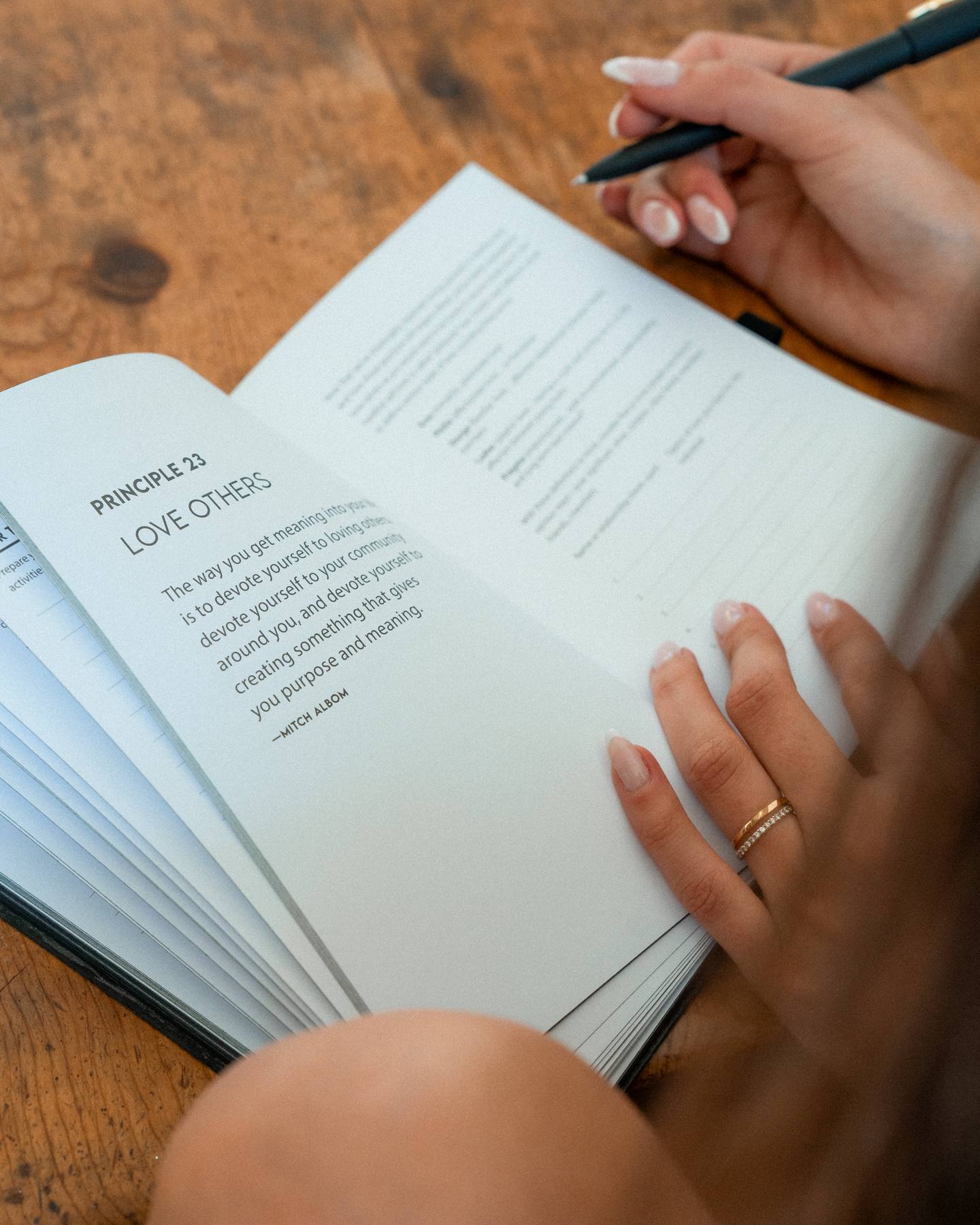
The Epic Journal solves the blank-page problem by never handing you a blank page to begin with. Every session in its 30-day guided morning and evening format is built around a specific prompt tied to one of 28 Principles of an Epic Life, so the question is already chosen before you sit down. You're not deciding what to write, you're just answering.
The journal itself is 279 pages, A5, bound in matte black vegan leather with a blind-embossed cover, a pen loop, and lay-flat binding so it stays open on the page you're actually using. The prompts are built on a behavioral-health curriculum developed for an accredited program, adapted here into a daily structure anyone can use, not just people in a clinical setting. It was created by founder Preston Durnford after 13 years working in addiction recovery, including losing his father to suicide and his brother to a fentanyl overdose. You can read his full story on the about page.
Right now it holds a 4.6 out of 5 rating from verified buyers. It's $39 for a single journal, $34 each in a 2-pack, and $32 each in a 3-pack, with free US shipping over $75 and a 2-day ship time from Southern California. If the blank page has been the thing standing between you and a consistent practice, structure solves that more reliably than willpower ever will. You can see the full The Epic Journal here.
Frequently asked questions
What is the best thing to write when you have no idea what to journal about?
The best thing to write is an answer to one specific, narrow question rather than an attempt at open-ended writing. Pick a single prompt, such as naming whatever is taking up the most space in your head right now, and write two or three honest sentences in response.
Is it normal to not know what to write in a journal?
Yes, not knowing what to write is one of the most common reasons people stop journaling, and it is a structure problem rather than a personal failing. A blank page asks you to invent both a topic and a format at the same time, which is a heavier lift than most people expect from a few quiet minutes.
Do guided journals actually help with the blank-page problem?
Guided journals help because they remove the need to invent a topic every day and replace it with a specific prompt already chosen for you. The Epic Journal, for example, pairs a daily prompt with one of 28 Principles of an Epic Life, so you always know exactly what to write before you sit down.