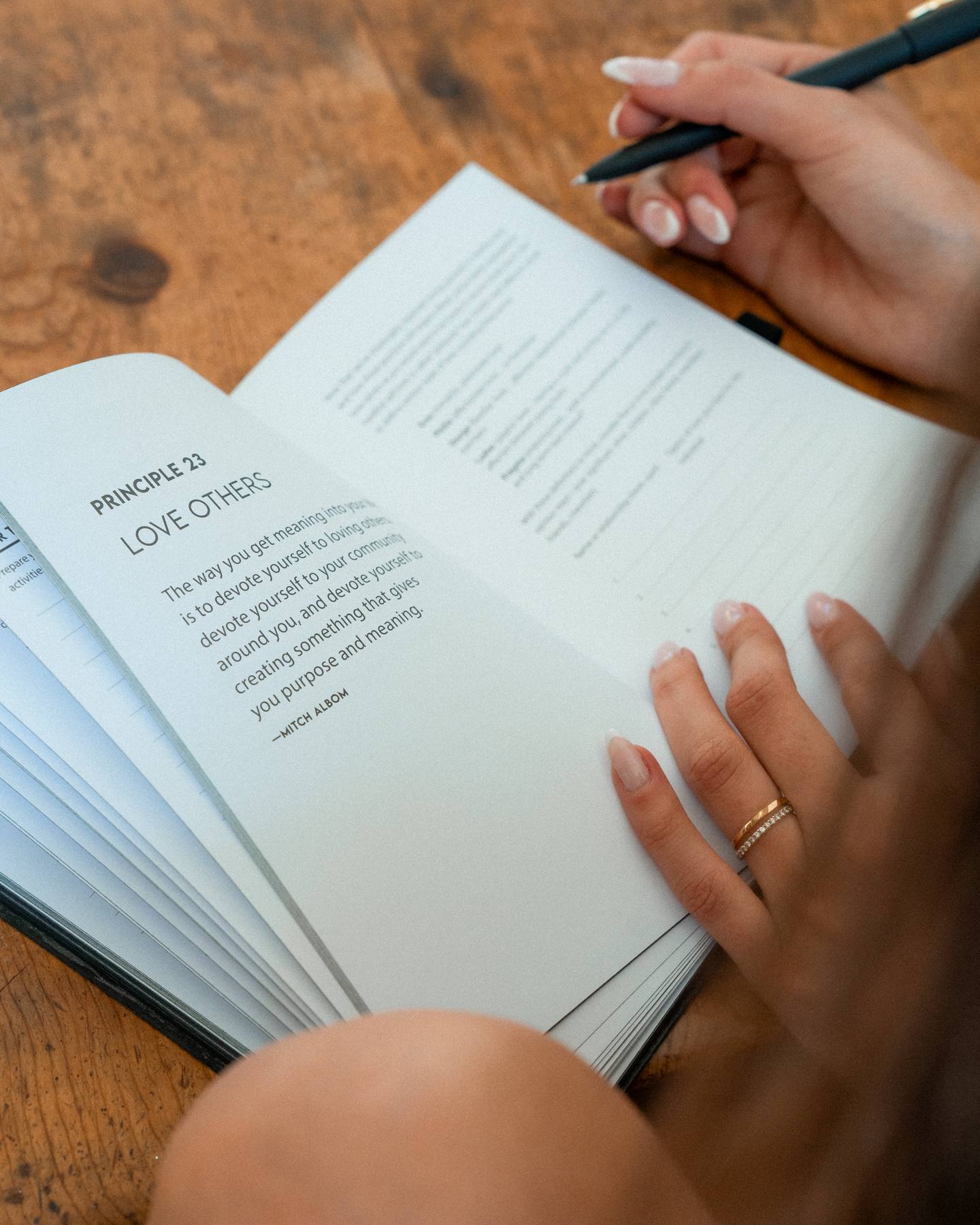
A guided journal outperforms free writing for most people because it removes the two things that make a blank page hard: deciding what to write about, and deciding when you've written enough. Prompts lower the mental effort needed to start, which is why structured formats get used more consistently over weeks and months than an empty notebook. Free writing still has real value, but as a daily habit for most people, structure wins.
Key takeaways
- Guided journals reduce the mental work of starting by supplying the topic and the format, which is why they get used more consistently than a blank notebook.
- Free writing asks you to invent both the subject and the structure every time, and that cost is the main reason the habit fades.
- Unstructured emotional writing can sometimes increase distress in the short term because it has no built-in stopping point or direction.
- Across consistency, follow-through, emotional safety, and time to start, guided formats win the comparison for most people.
- Free writing still has a place for experienced writers or specific creative work, it just is not the safer daily default.
What is the actual difference between a guided journal and free writing?
The core difference is who decides what gets written. A guided journal supplies a prompt, a topic, and a stopping point built into the page, while free writing leaves all three entirely up to you. That sounds small until you sit down at the end of a long day and have to invent them from nothing. Here is how the two approaches compare.
| Factor | Guided journal | Free writing / blank notebook |
|---|---|---|
| Consistency | High. A fixed daily prompt removes the "what to write" decision, so the practice repeats easily. | Low to moderate. Sessions depend on mood and motivation, which vary day to day. |
| Follow-through | Higher. A defined start and end point, often a set number of prompts per page, gives each session a clear finish line. | Lower. Entries can run long and open-ended, which makes them feel bigger than a few minutes and easy to skip. |
| Emotional safety | Generally safer. Prompts guide reflection toward a specific, bounded topic instead of open-ended dwelling. | Variable. Without direction, writing about distress can slide into unstructured rumination for some people. |
| Time to start | Seconds. The page already tells you what to do, so writing can begin immediately. | Minutes, or longer. Deciding what to write about is its own separate task before any writing happens. |
Why does a blank page create more resistance than a guided prompt?
A blank page creates more resistance because it forces your brain to do two jobs at once: invent a format and generate content, before a single word gets written. Cognitive scientist John Sweller's cognitive load theory, described in the journal Cognitive Science, explains why: working memory has limited capacity, and open-ended tasks consume far more of it than tasks with a defined structure. A prompt does the format-inventing work for you, so the only job left is answering it, a much smaller ask on a tired Tuesday night, which is exactly when most journaling habits are won or lost.
Can free writing without structure make you feel worse instead of better?
It can, for some people. Writing about distressing feelings without any prompt, focus, or stopping point can turn into what psychologists call rumination: circling the same negative thoughts without moving toward resolution. Psychologist Susan Nolen-Hoeksema's research on rumination, published in the Journal of Abnormal Psychology, found that dwelling on distressing feelings without a structured outlet was associated with longer and more intense negative moods, not relief. By contrast, James Pennebaker's well-known studies on expressive writing, also published in the Journal of Abnormal Psychology, gave participants a specific prompt and a fixed time limit, and those structured sessions produced more consistent benefits than open-ended writing did. This is why a guided approach helps: it encourages reflection with a direction and an endpoint. It works alongside professional help, not instead of it, for anyone working through anxiety, grief, or trauma.
Does structure actually change whether people keep the practice going?
Yes. Structure changes follow-through because it turns a vague intention like "journal more" into a specific, repeatable action with a known shape. This is the reasoning behind The Epic Journal's 28 Principles of an Epic Life, laid out as a 30-day guided morning and evening practice. The prompts are built on a behavioral-health curriculum developed for an accredited treatment program, adapted into a structured daily format that supports reflection instead of leaving it open-ended. If you already journal but want more consistency, our guide on building a journaling habit that actually sticks covers the mechanics.
Is free writing ever the better choice?
Free writing suits people who already have an established writing habit, or who use a notebook for a specific creative purpose like drafting or brainstorming. For those cases, an open page is a feature, not a gap. But as a daily practice for building consistency or starting a habit that lasts past week two, an unstructured notebook asks more of you than most people can reliably give it.
What do people usually ask about guided journals versus free writing?
Three questions come up most often. Here are direct answers to each.
Is a guided journal better than a blank notebook?
For most people, yes. A guided journal removes the two decisions that stop free writing before it starts: what to write about and when to stop. A blank notebook can still work well for someone who already writes daily without prompts, but it asks more of you before a single word gets written.
What is the difference between guided journaling and free writing?
Guided journaling gives you a specific prompt and a defined format for each entry, while free writing leaves both the topic and the length completely open. That single difference is why guided journaling tends to produce more consistent daily practice, while free writing tends to produce occasional long entries followed by long gaps.
Can journaling without a prompt make anxiety or distress worse?
It can for some people. Writing about distressing feelings without any structure or stopping point can slide into rumination, which research has linked to longer and more intense negative moods rather than relief. A guided format with a defined prompt and length helps keep the practice constructive. This works alongside professional help, not instead of it, for anyone dealing with significant anxiety or trauma.
So which one should you actually use?
If you have tried a blank notebook before and it fizzled out by week two, the notebook was probably never the problem. The missing piece was usually structure: a reason to sit down, a format that fits in five minutes, and a stopping point that tells you the entry is done. That is the design behind The Epic Journal, a 30-day guided morning and evening practice built around 28 Principles of an Epic Life. You can read more about why it was built this way, including the founder's story, on our about page. If a blank page has never quite worked for you, a little structure may be the only thing that was missing.
One well known exception worth knowing about: Morning Pages, Julia Cameron's three-page writing practice, is technically free writing, but it carries its own built-in structure that a blank page usually lacks.